
Formula Mass Calculator
Formula mass is the sum of the atomic masses of every atom in a formula. This calculator shows the working the way a teacher expects it: each element, how many atoms, its atomic mass and the product, then the total in atomic mass units (u). It handles brackets and hydrates, and a second mode works backwards from percentage composition to the empirical formula.
- Free to use
- No sign-up
- Runs in your browser
Formula mass calculator
Use correct capitals (Co is cobalt, CO is carbon monoxide). Write hydrates with a dot or asterisk: CuSO4*5H2O.
Formula Mass Worksheets
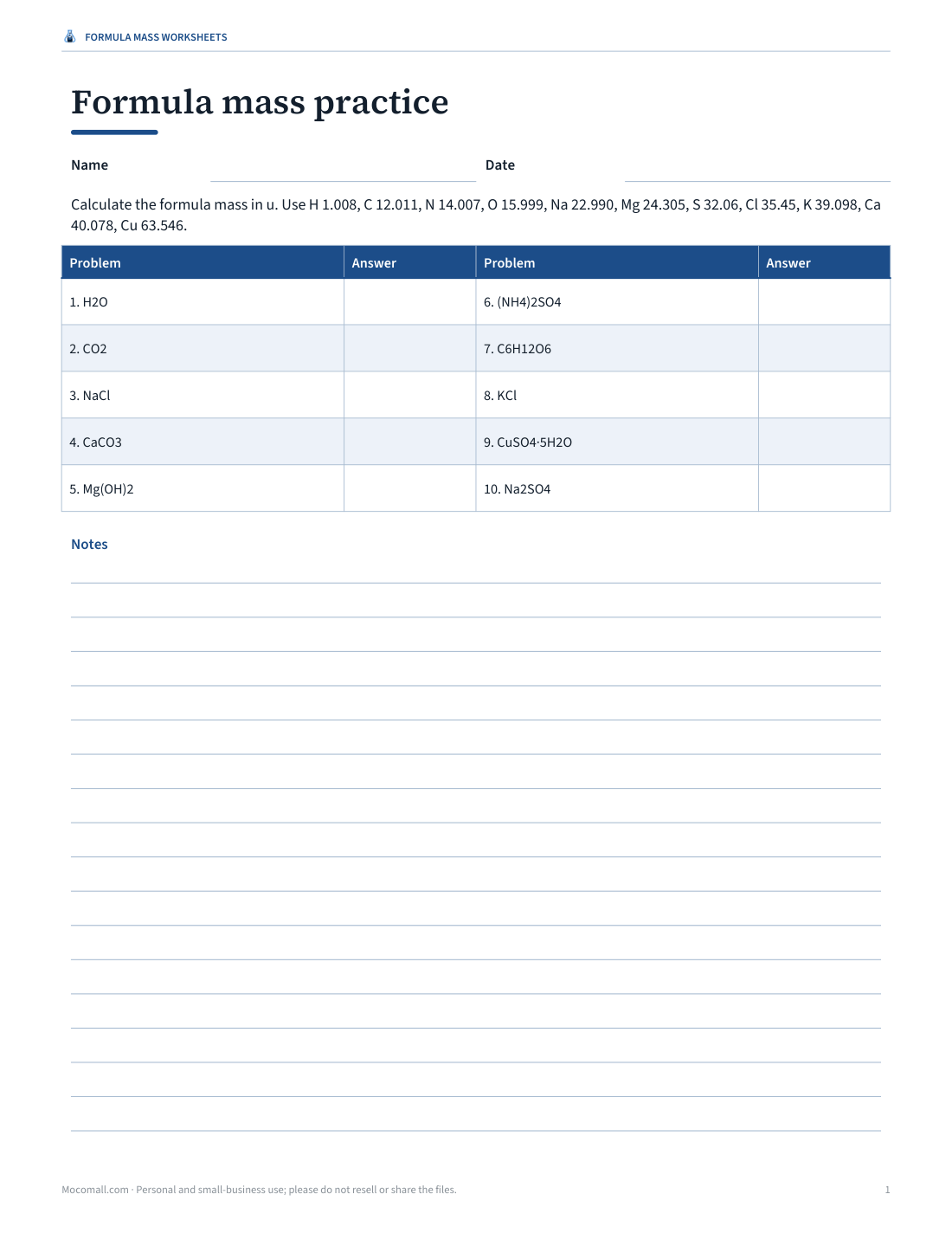
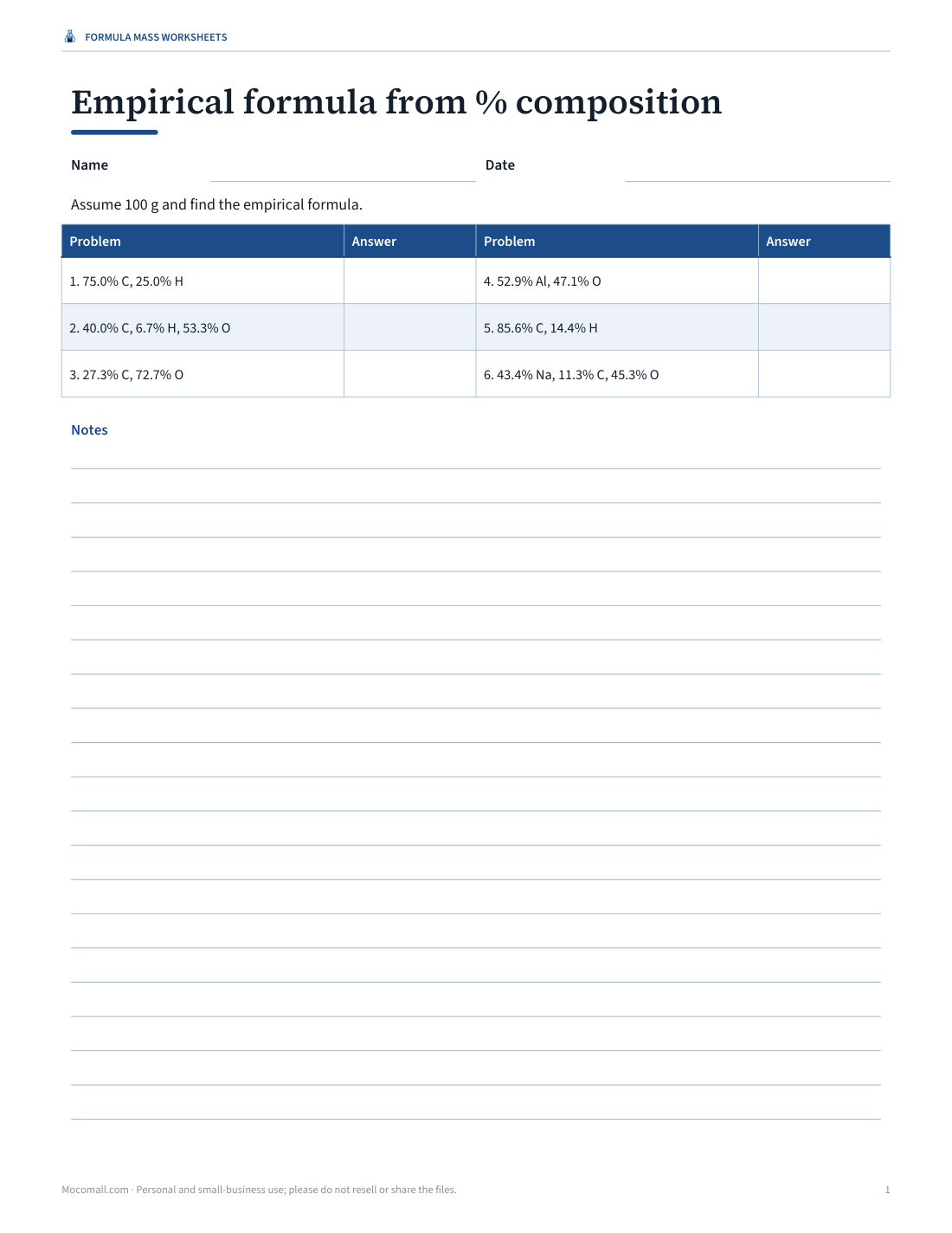
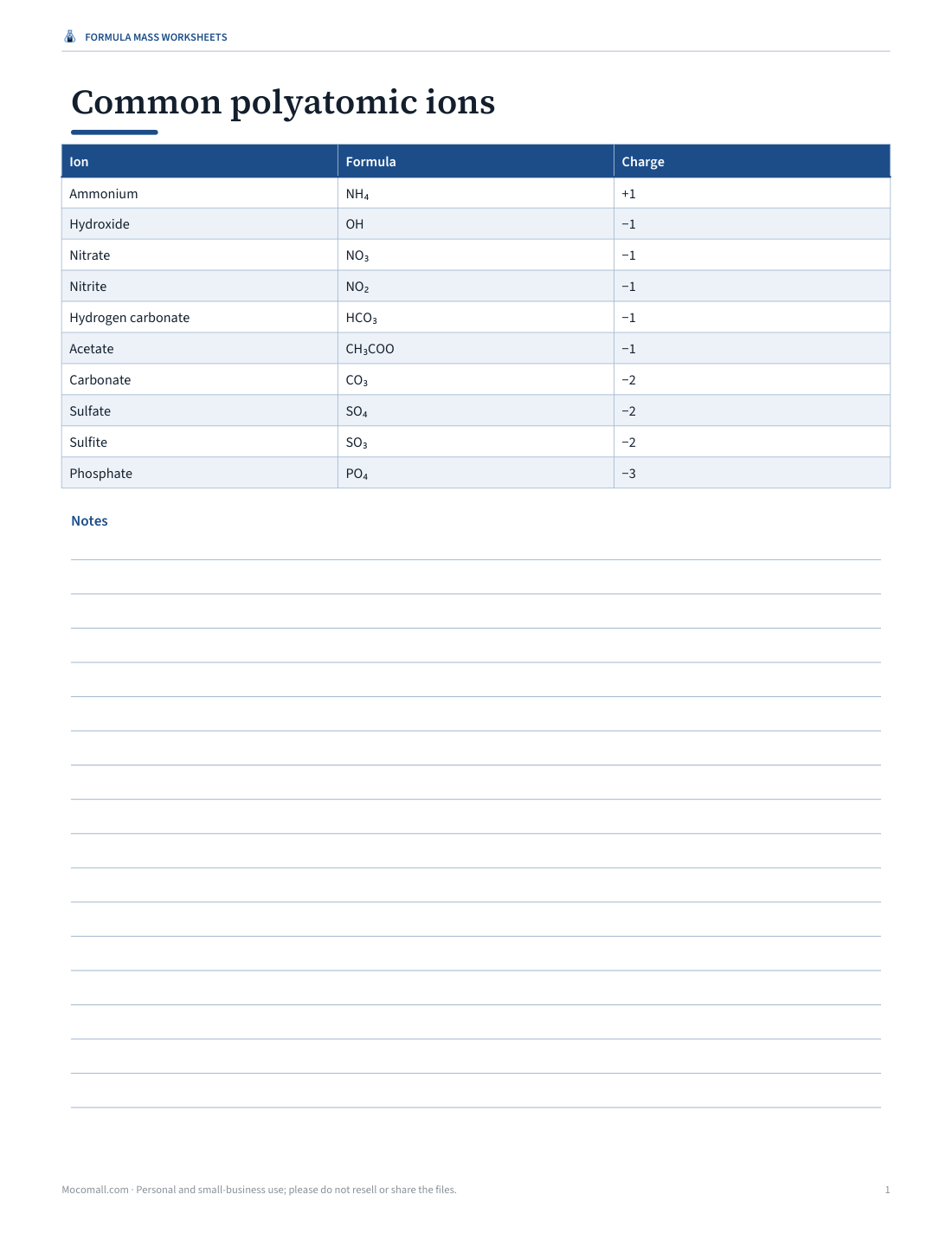
Formula mass practice worksheets with worked answers, an empirical formula worksheet, a common and polyatomic ions chart and an atomic mass reference table.
- Formula mass practice (PDF, DOCX)
- Empirical formula (PDF, DOCX)
- Ions chart (PDF/XLSX)
- Atomic masses (PDF/XLSX)
Formats: PDF, DOCX, XLSX. Instant download after payment (link valid 72 hours, up to 5 downloads). AI-assisted: the templates were drafted with AI help and reviewed and laid out before publishing.
$5.00 USD, one-time 4 files · about $1.25 each
- Instant download
- 7-day refund
- Secure checkout by Stripe
7-day money-back guarantee. Full refund within 7 days of purchase, even after you download.
Free sample: Formula Mass Practice (PDF, 55 KB)
Full refund within 7 days — see the refund policy and license.
Free printables
Single sheets you can print right now, no sign-up. The full pack adds every sheet in one download plus the editable files.
 Printable Formula Mass Practice Sheet
 Printable Empirical Formula Worksheet
 Printable Common Ions Chart
 Printable Atomic Masses Chart
Formula mass, molecular mass and molar mass
| Term | Meaning | Units |
|---|---|---|
| Formula mass | Sum of atomic masses in a formula unit — used for any compound, including ionic ones like NaCl | u (atomic mass units, also called daltons) |
| Molecular mass | The same sum for a molecule (covalent compounds such as H₂O) | u |
| Molar mass | Mass of one mole of the substance; numerically equal to the formula mass | g/mol |
Ionic compounds such as sodium chloride don’t form separate molecules — they are lattices of ions — so chemists speak of a formula unit and its formula mass. The arithmetic is exactly the same.
How to calculate formula mass
- Write the formula and count the atoms of each element. A subscript applies to the element just before it; a subscript after brackets multiplies everything inside.
- Look up each element’s atomic mass on the periodic table.
- Multiply each atomic mass by the number of atoms.
- Add the results.
- Give the answer in u (or g/mol for molar mass) and round sensibly.
Worked example: copper(II) sulfate pentahydrate
| Element | Atoms | Atomic mass (u) | Subtotal (u) |
|---|---|---|---|
| Cu | 1 | 63.546 | 63.546 |
| S | 1 | 32.06 | 32.060 |
| O | 4 + 5 = 9 | 15.999 | 143.991 |
| H | 10 | 1.008 | 10.080 |
| Total | 249.677 u |
In CuSO4·5H2O the dot means five water molecules are attached to each CuSO4 unit, so there are 4 oxygen atoms in the sulfate plus 5 in the water, and 10 hydrogen atoms. The water contributes 5 × 18.015 = 90.08 u, which is 36.1% of the total — the mass lost when the blue crystals are heated to white anhydrous copper sulfate.
Brackets and subscripts
- Ca(OH)2: the 2 applies to both O and H — 1 Ca, 2 O, 2 H.
- (NH4)2SO4: 2 N, 8 H, 1 S, 4 O.
- Al2(SO4)3: 2 Al, 3 S, 12 O.
- Coefficients in front of a formula (2H2O) are not part of the formula mass — they count molecules in an equation.
Empirical formula from percentages
- Assume 100 g of the compound, so each percentage becomes a mass in grams.
- Divide each mass by the element’s atomic mass to get moles.
- Divide every mole value by the smallest one.
- If the ratios are not whole numbers, multiply them all by a small number (2, 3, 4…) until they are — 1.5 means ×2, 1.33 means ×3.
- Write the formula with those whole numbers as subscripts.
The default example — 40.00% C, 6.71% H and 53.29% O — gives mole ratios of about 1 : 2 : 1, so the empirical formula is CH₂O. Glucose (C₆H₁₂O₆) and acetic acid (C₂H₄O₂) both have this empirical formula; you need the molar mass to find the molecular formula.
From empirical to molecular formula
Divide the compound’s measured molar mass by the empirical formula mass and multiply the subscripts by the result. CH₂O has a formula mass of 30.03 u; if the compound’s molar mass is 180.16 g/mol, 180.16 ÷ 30.03 = 6, so the molecular formula is C₆H₁₂O₆.
Percentage composition
Once you have the formula mass, the percentage of each element is its subtotal divided by the total, times 100. In water, hydrogen contributes 2.016 u out of 18.015 u, so water is 11.19% hydrogen and 88.81% oxygen by mass. The calculator lists the percentage of every element under the result, which is handy for checking empirical-formula questions in reverse.
Common mistakes
- Forgetting to multiply everything inside brackets by the outside subscript.
- Adding the coefficient of a balanced equation into the formula mass.
- Mixing up element symbols: Co (cobalt) vs CO (carbon + oxygen), Cl vs Cl2 in formulas.
- Rounding atomic masses too early — round only the final answer.
- Leaving out the water in a hydrate, or counting its hydrogen and oxygen twice.
Why atomic masses are not whole numbers
Most elements are a mixture of isotopes with different masses. Chlorine, for example, is roughly three-quarters chlorine-35 and one-quarter chlorine-37, so its average atomic mass is about 35.45 u. The periodic table lists these weighted averages, which is why formula masses come out with decimals.
Atomic masses used
The calculator uses standard atomic weights rounded as they appear on most school periodic tables (for example H 1.008, C 12.011, O 15.999). Your textbook may round differently — to 1, 12 and 16 — which changes answers in the second decimal place, so follow your course’s convention.
Chemistry printables
The optional pack includes formula mass practice worksheets with full worked answers, an empirical formula worksheet, a common ions and polyatomic ions chart and a printable atomic mass reference table. The calculator above is free to use.
AI-assisted content
This page was drafted with AI assistance and reviewed before publishing.
Frequently asked questions
What is formula mass?
The sum of the atomic masses of all atoms in a formula unit, in atomic mass units (u).
Is formula mass the same as molar mass?
They have the same number; formula mass is in u, molar mass in g/mol.
What is the formula mass of water?
About 18.015 u.
How do I handle brackets?
Multiply everything inside the brackets by the subscript after them.
How do hydrates work?
Add the mass of the water molecules shown after the dot, e.g. 5H2O adds 5 × 18.015 u.
Can it find an empirical formula?
Yes, switch to the % composition mode.
What is the unit u?
The unified atomic mass unit, one-twelfth of the mass of a carbon-12 atom; also called a dalton (Da).